
You decide on Monday to add NAD+ to the menu. The supplies land Wednesday. Your nurse is trained and keen. So you plan to start taking bookings Friday.
Friday comes and you're not taking bookings. Somewhere between the decision and the first client there's a list nobody warned you about. Not a long list. Just one you didn't know existed until you were standing in it.
Here's what actually sits between "we're adding this" and "someone can book it" — and why NomadMD asks you for all of it in one place instead of letting you put half of it on the menu and keep the rest in a folder.
In most software, a service is three fields
Open almost any booking tool and adding a service means a name, a price, and a length. Save. It's on the menu.
That's genuinely all a haircut needs. For anything clinical it's about a third of the picture, and the missing two thirds don't disappear — they just end up somewhere else. A consent PDF in Google Drive. A protocol screenshotted into the group chat. A note in someone's phone about which nurse is signed off on it.
Everything still works, right up until it doesn't. The client books. The nurse arrives. And then: which consent form is the current one, is this the dose we settled on, and wait — is she actually cleared for this?
What has to exist before you can sell it?
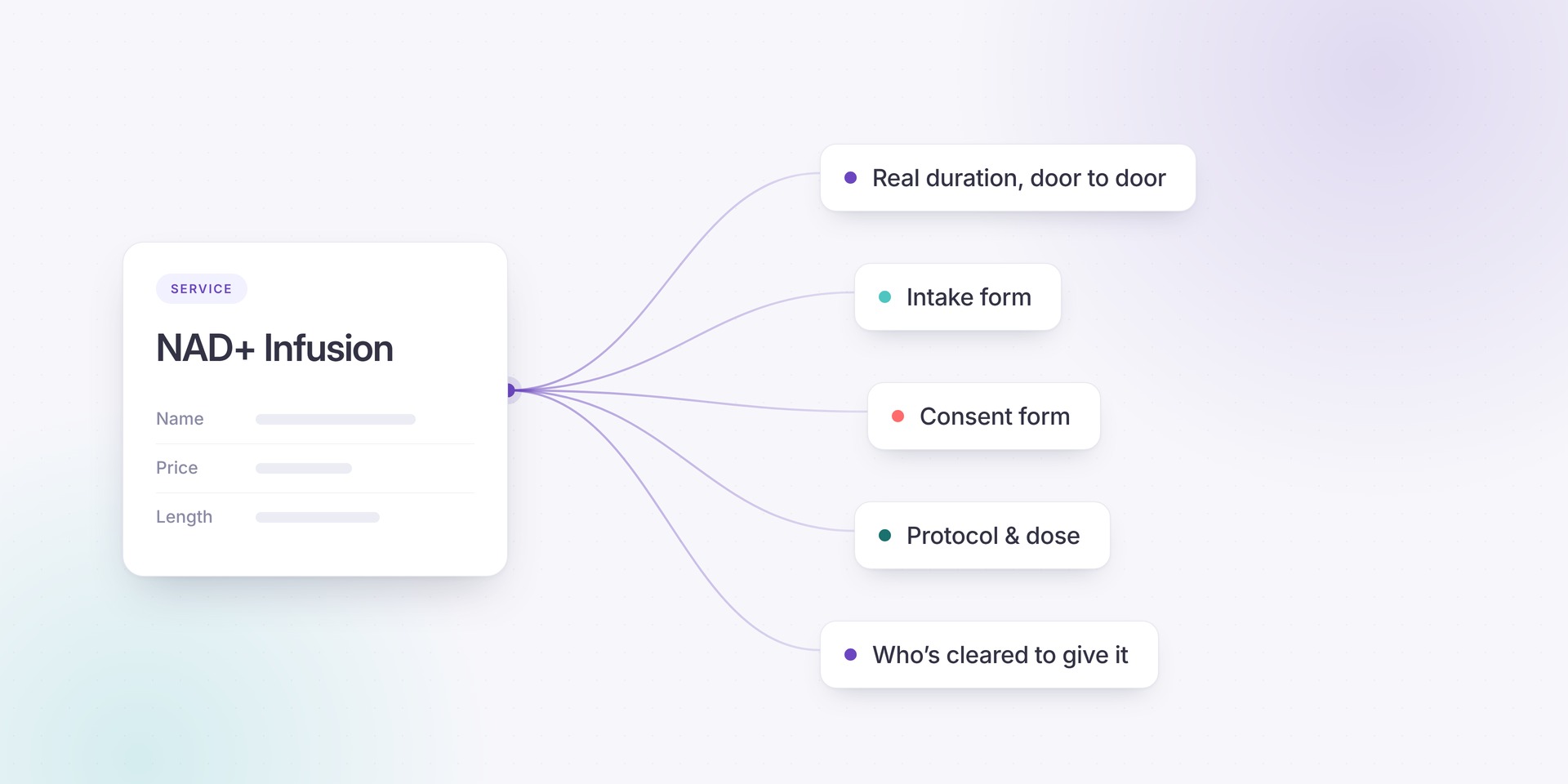
1. The price, and how long it really takes. Not the drip time. The whole visit, door to door, including setup, the chat, and the pack-down. A sixty-minute treatment that blocks ninety minutes of a nurse's day is a ninety-minute service, and pricing it as sixty is how a calendar quietly stops being true.
2. The intake questions for this specific service. Your standard hydration intake probably doesn't ask what a new service needs to ask. Different contraindications, different history, different things worth knowing before someone's in a chair. One generic form across every service is how a question that mattered gets skipped.
3. The consent for this specific service. Same logic, and this is the one most likely to be living as a PDF someone emails around. When a service and its consent form aren't attached to each other, the day eventually arrives when the wrong version gets signed.
4. The protocol — what goes in and how much. The ingredients, the dose, and the sign-off from whoever is medically responsible. This is a real document with a real signature behind it, and it belongs attached to the thing it governs rather than to a conversation that happened in March.
5. Who's allowed to give it. The one people forget. Not everyone on your team is trained or credentialed for everything you sell. If the system doesn't know that, it will cheerfully book the new service with the nurse who's never done it.
Four of these are paperwork. The fifth is a permission. None of them are optional, and all of them are invisible until the moment they're not.
Why does the folder-and-group-chat version break?
For a mobile IV practice with one service and one nurse, it works fine. You remember everything, because there isn't much to remember.
It starts failing at about four services and three providers, and it fails in a specific way: not dramatically, but quietly. Someone uses last quarter's consent. Someone gives a dose from a version of the protocol that got updated. A booking lands with a provider who isn't cleared, and the first anyone knows is when she's parked outside the client's house.
These aren't carelessness. They're what happens when the thing that governs the service lives somewhere other than the service.
What changes when it's attached
In NomadMD a service carries its own paperwork. The intake form, the charting form, the consent documents, and the medication protocol with its dose are all part of the service definition, not separate things you hope line up.
So when a client books it, the right intake goes out. When the provider arrives, the right consent is on their screen and the right protocol is in front of them. There's no current version question, because there's only one version attached.
Permissions work the same way. Services get bundled into a set, and that set gets assigned to the providers who can deliver it. If someone isn't assigned, they don't get offered the job. You don't have to remember who's cleared for what, which is good, because eventually you won't.
Why this matters more than it sounds
If you're opening a mobile IV practice, this is the part of setup that takes the time. Not the website, not the branding — the four pieces of paper and one permission behind each thing you sell. Knowing that upfront is the difference between a two-week launch and a six-week one.
If you're adding services, it's the reason expansion feels slower than it should. Each new offering is its own small project, and a tool that only stores a name and a price makes it feel like an admin problem rather than a setup step.
And if you're looking at platforms, it's a question worth asking in the demo. Not "can I add a service" — everything can. Ask to see where the consent form and the protocol live, and who decides which providers can deliver it. The answer tells you whether you're buying a menu or a system.
The short version
Adding a service isn't a menu edit. It's a price, a realistic duration, an intake form, a consent form, a signed protocol, and a list of who's cleared.
You're going to produce all six either way. The only question is whether they live attached to the service, or scattered across a drive, a group chat, and your memory — and which of those you'd rather rely on at 9am at a stranger's kitchen table. In mobile IV work, nobody is down the hall to ask.